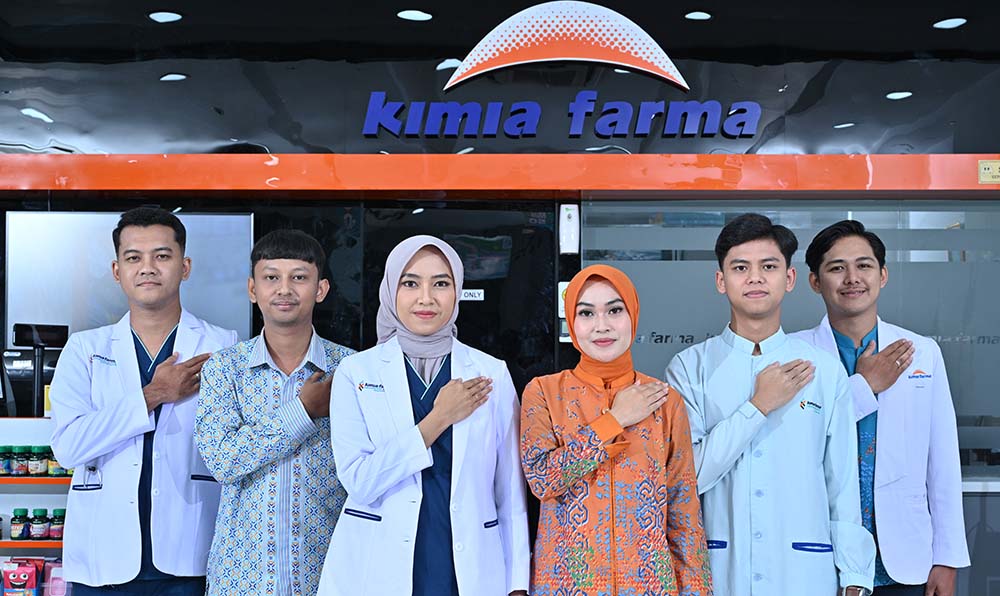
PT Kimia Farma (Persero) Tbk (“KAEF”) recorded improved performance in the first semester of 2026. As a member of the State-Owned Enterprise (SOE) Pharmaceutical Holding under PT Bio Farma (Persero)—and with strengthened support from Danantara Asset Management (“DAM”)—KAEF posted an unaudited net profit of IDR 54.07 billion. This achievement marks a turnaround from the same period the previous year, when the Company recorded a net loss of IDR 135.61 billion.
This positive performance was driven by net sales growth reaching IDR 4.70 trillion, a 7.6% increase from the IDR 4.36 trillion recorded in the first semester of 2025. On the operational front, the Company’s operating profit rose by 111.3% to IDR 152.21 billion, up from IDR 72.01 billion in the same period the previous year.
Djagad Prakasa Dwialam, President Director of PT Kimia Farma (Persero) Tbk, stated that this performance improvement is the result of the Company's ongoing efforts to strengthen its business fundamentals.
“With support and guidance from Danantara, KAEF continues to reinforce its business foundation through portfolio management, operational efficiency, production strengthening, and governance improvements. The positive performance in the first semester of 2026 demonstrates that the transformation process is moving in a healthier and more measured direction. With a healthier business, KAEF is better positioned to support the availability of medicines, healthcare services, and national priority programs,” said Djagad on Wednesday (August 5).
However, geopolitical dynamics in the Middle East during the second quarter of 2026 continued to exert pressure on the Company, primarily through rising prices for raw materials and packaging materials, a portion of which are still imported. The Company continues to closely monitor these developments, including their impact on supply chain stability and production costs. To mitigate these pressures, the Company is implementing further efficiency programs, strengthening cost controls, and making measured price adjustments for select products. These measures are essential to maintaining supply continuity, product quality, and healthy margins amidst rising raw material and packaging costs.
Improved performance is also reflected in the operating expense-to-sales ratio, which declined from 34.2% in the first half of 2025 to 33.2% in the first half of 2026. This reduction indicates that cost-efficiency measures are beginning to impact the Company’s operational structure.
KAEF continues to pursue a phased business transformation centered on six key areas: working capital resilience, strengthening human resource (HR) competencies, business process digitalization, operational efficiency, reinforcing corporate governance (GCG), and fostering synergy among entities within the Kimia Farma Group.
KAEF Accelerates Pharmaceutical Self-Reliance and National Healthcare Service Infrastructure
To strengthen national self-reliance regarding pharmaceutical raw materials (BBO), KAEF continues to optimize its drug production facilities. The Company is optimizing production facilities in Jakarta and Banjaran to serve as the production backbone for 50 key products, including essential medicines such as Amlodipine, Codeine, Morphine, and Abacavir.
Upstream, KAEF is reinforcing the roles of Kimia Farma Sungwun Pharmacopia (KFSP) and PT Sinkona Indonesia Lestari (SIL) in the development of local pharmaceutical raw materials. Currently, KFSP holds Good Manufacturing Practice (GMP/CPOB) certification from BPOM for 19 raw materials, 18 of which are also Halal certified by the Halal Product Assurance Organizing Agency (BPJPH).
KAEF is also actively driving the localization of priority products that support government programs but have historically relied on imports. This initiative aims to strengthen supply chain resilience, reduce dependence on external sources, and ensure the domestic availability of priority products.
This upstream acceleration is further supported by KAEF’s extensive and integrated downstream ecosystem. As of June 2026, Kimia Farma operates over 1,000 pharmacies, more than 350 clinics, and over 60 laboratories across Indonesia. This network serves as a key foundation for the Kimia Farma Group in supporting public healthcare services.
Through this network, KAEF serves 23 million BPJS Kesehatan patients, supports government priority programs—such as addressing stunting and eliminating Tuberculosis (TB)—and develops integrated services for the elderly (elderly care).
"Looking ahead, we are optimistic that with the support of Danantara Asset Management and strengthened synergy within the SOE Pharmaceutical Holding, KAEF’s transformation can proceed in a more focused manner. Our focus remains on strengthening a healthy business, ensuring medicine availability, enhancing healthcare services, and supporting national priority programs," concluded Djagad.